
At the interface between physics and biology, one of the most vibrant areas of study is active matter. Ilya Prigogine, among the greatest scientists of the 20th century, laid the theoretical groundwork for “dissipative systems” over 50 years ago, describing how matter that absorbs energy can maintain a state of non-equilibrium in “self-organizing systems.” Reductionist science holds that life itself is just that: self-organizing. Over the last ten years, progress in the application of Prigogine’s work to biology has exploded. Solving the mystery of “self-organizing systems” beyond tornadoes and whirlpools and expanding it to the study of organisms is now underway.
Question Without an Answer
For more than a half century, the physical science of organisms has been almost the exclusive domain of molecular biology, by which life was supposed to have been reduced to chemical reactions. The wonders of DNA replication, protein synthesis, and cellular respiration, all the way down to the fate of sub-atomic particles in the electron transport chain, have been intricately mapped through rigorous biochemistry research. The reduction seemed complete except for one crucial question, “How was all of this organized?”
In medical school I was taught to memorize the many steps in the TCA cycle, studying the pathways from a sheet of paper. Yet how do all these enzymes and intermediate chemical products find their proper way in and out of the cycles and cascades, without bumping into each other or getting lost altogether? Is there a structure that supports the function?
The Structure/Function Debate
At Science and Culture, I have described how materialist science reduces the complexity of life to the structure-function relationship in order to rationalize the neo-Darwinian randomness-selection hypothesis. I made the case that structure and function are a complementarity, and that any distinction between them was a mere linguistic fiction. That fiction is a major pillar in the framework of scientific atheism. Demolishing that pillar profoundly undermines the atheistic argument regarding life.
Can the physics of active matter rescue scientific atheism by reasserting the necessity of the structure-function duality in order to support neo-Darwinism? It seems that that is just what many researchers are aiming for. After all, if matter can actively self-organize into structures that confer function in living systems, the once-reigning paradigm of naturalism might be re-invigorated.
As always, the approach of naturalism is to reduce the complexity of natural phenomena to basic physical laws. That way there is no need for any mystical or divine agency to account for the intricacies of life. Can the properties of active matter step in to reduce the otherwise bewildering complexity of intracellular dynamics?
The Cell Is Not a Machine
In any exploration of new territory, the most prominent landmarks are the initial objects of interest. That is why the major chemical reactions that support life, including DNA transcription and the rest, were the first things to be dissected from the cell and rigorously mapped out, ex vivo. Next came the membrane-bound intracellular compartments that isolate some of these complex reactions, such as the nucleus, endoplasmic reticulum, lysosomes, mitochondria, Golgi bodies, etc. So far so good.
But from going deeper into the frontier of the intracellular landscape, it became apparent that much of the intracellular chemistry is actually taking place in non-membrane bound areas of the cytoplasm. Which raises the same question I asked above, “How are all the extremely complicated and precise chemical reactions of the cell coordinated?”
We understand how complicated mechanisms occur within machines, and so we often mistakenly project that model onto our study of cellular biology. But the cell is not a machine. There are no rigid scaffolds or gears or pulleys or chips or circuits of insulated wiring that separate one mechanism from another in the cytoplasm. Within the cell, a hundred different chemical reactions are all thrown together into the mix. Obviously, the need for “self-organization” is great!
Biomolecular Condensates
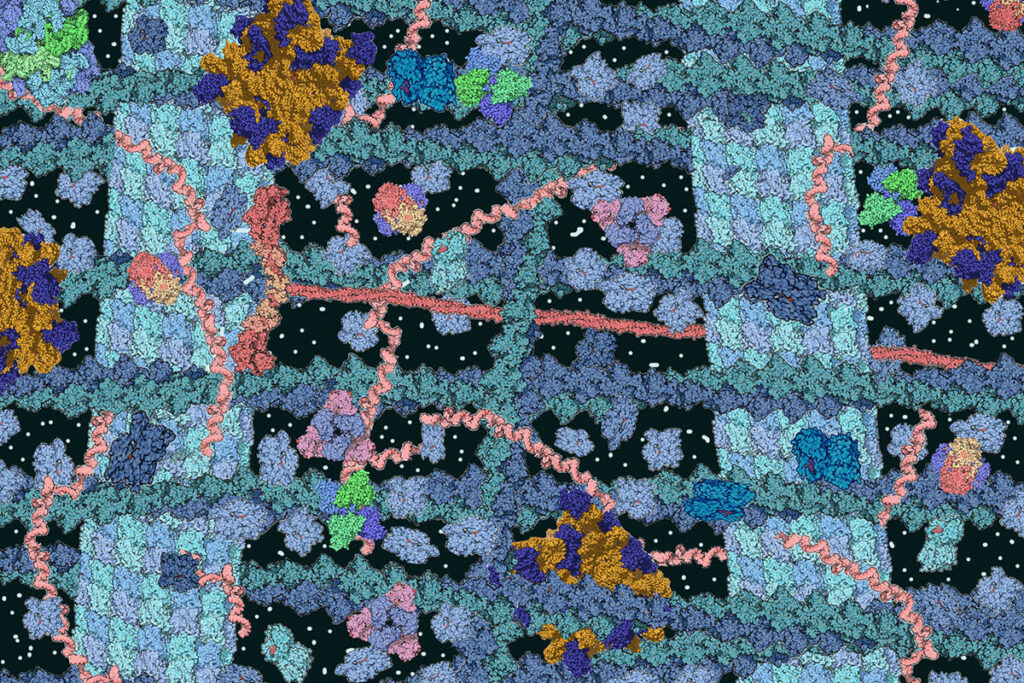
To address these questions, the focus has turned to the dynamics of the cytoplasm itself. And, not to be outdone by the genetic code or the electron transport chain, it has recently been ascertained that the cytoplasm is indeed “self-organized’ in a particular and quite novel way. The cytoplasm is a mixture of chemical constituents of all sizes, from electrolytes to macromolecules and everything in between. Active matter biophysics has recently demonstrated the ability of the cytoplasm to partition itself into membrane-less liquid droplets of varying viscosity which constrain, isolate, regulate, and chaperone the multitude of chemical constituents. The complex intracellular molecular activity of the cytoplasm is orchestrated by this process. These liquid-liquid phase separations (LLPS) are termed biomolecular condensates.
Here is a description from the literature of how biomolecular condensates operate. From Riccardo Babic, et al., writing in Trends in Biochemical Sciences, “Autophagy regulation by phase separation, avidity, and wetting”:
“Specific cargoes must be identified within the crowded cytosol, and a precise machinery must assemble de novo … How is a diffuse, active cytosol transformed into a well-coordinated machinery? … Phase separation describes the process by which networks of weak, multivalent interactions between macromolecules lead to the formation of gel-like condensates, characterized as viscoelastic, that can assemble, remodel and disassemble…”
Biomolecular condensates exhibit properties exquisitely adapted to the needs of the cell, and some of these properties can in fact be reduced to valances, viscosities, etc. But there can be no mistaking the obligate explanatory language used to describe how these properties are manifested, e.g., cargo recognition, signaling cascades, molecular grammar, 3D spatial organization, and even “molecular Velcro.”The biophysical perspective is that matter activated by energy can attain such a state of non-equilibrium. But does that explain how matter can perform all these normative tasks essential to life?
The Cart, the Horse, and the Failure of Dualism
When biochemists began to explain life from a molecular basis 70 years ago, the exceedingly simple understanding we had at that time lent itself to the misguided structure/function dualism.
Nucleotide transcription/translation, lock and key enzyme activity, et al., readily pointed to the very simple notion that once molecules attained a given structure, thereafter a function would result. But digging deeper, we can now see that the complexity of life is not so readily reduced. The very brief description above describes a system that is by no means reducible in the linear chemical reaction understanding that we had in 1970. The authors write further:
“Recognizing phase separation as a fundamental organizing principle has redefined our understanding of autophagy, not as a linear sequence of molecular events but as a spatially and temporally regulated process governed by biomolecular condensates…”
As we look deeper into life, we no longer see any linear pathways! Instead, we discover a web of complex functions necessary for life that emerge in the irreducible fashion described by Michael Behe in Darwin’s Black Box (1996). Active matter properties that manifest themselves in such phenomena as so-called biomolecular condensates demonstrate the fact that there are no straightforward linear structure-function relationships to account for the deep complexity of cytoplasmic function. Instead, we find uncoded, multilayered, amorphous “viscoelastic droplets” that emerge out of the physics of phase separation.
On the surface one might even be tempted to see such a messy process as random. But then we recognize that these “droplets” perform precise, exquisitely complex normative duties that are “governed by molecular condensates.” Governance isn’t random. It can only be accounted for on the basis of biologic intentionality. (See “Intentionality in Living Systems: What Does It Mean?”)
Unguided, the probability that the intricate functions performed by these unstructured droplets could emerge spontaneously by “self-organization” is so low as to be unimaginable. Because here we now see meticulous coordinated function arising in the absence of precise scaffolding structure. The behavior of active matter in the setting of cytoplasmic molecular coordination constitutes a most vivid example of the fact that life is generated by function, and that structure is secondary.
Reaching this profound conclusion takes us out of the realm of mechanism. That is as it should be, because the cell and all of life transcend mechanism. Goal-directedness resulting in function, aka Aristotle’s telos, is the guiding agency of life.
Or to put it another way, “All things,” as Aquinas tells us, “are ordered to their end.”
Read the Full Article on Science & Culture Today